Myriam Blin, Head, Charles Telfair Centre,
Mauritius is frequently cited as an example of post-colonial success. At the core of this developmental state success has been its ability to redistribute the proceeds of growth to prevent ‘class and sectorial exploitation’ (Johnson 1987: 142).
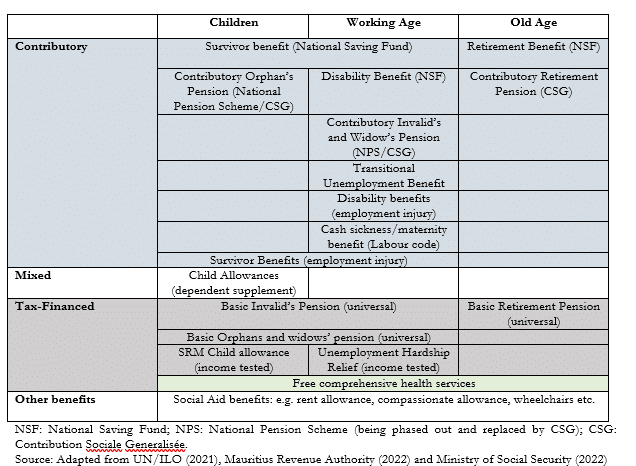
The country’s extensive and comprehensive welfare system covers free access to education and health, universal pension, unemployment benefits scheme, social cash transfers, social housing, and universal access to water. The welfare state succeeded in producing an educated and competent labour force and supported continued social peace while reducing inequalities. A particularly unusual achievement as Mauritius was increasingly opening to the global economy.
Social protection schemes and benefits in Mauritius
Today, however, this foundational system is under pressure. An ageing population, rising inequality, and severe fiscal constraints are rising challenges to the welfare state. The question the nation faces is: can the model be reformed without breaking the social contract that has ensured its peace and prosperity for over 50 years?
A Social Contract Forged in History
To answer this question, it is first important to analyse the foundation of the Mauritius welfare state. In a chapter, recently published in the Handbook of the Mauritian Economy, my research reviews the political economy of the Mauritian welfare state.
Its roots lie in the country’s colonial history and its struggle for independence. From the 1940s, grassroots movements and the Mauritius Labour Party (MLP), heavily influenced by Fabian socialism ideas, pushed a strong social welfare agenda to the colonial powers. This commitment was cemented in the social contract at independence. In a context of sharp inequalities and latent ethnic tensions, welfare provision was seen as essential for nation-building and social peace.
This foundation proved critical. The provision of free education, after the student riots of 1975, created a literate and skilled workforce that became the country’s key asset, first attracting investment into the textile industry and later enabling a transition into finance and technology. Simultaneously, the universal nature of social safety nets such as pension helped manage ethnic tensions, ensuring that the fruits of growth were, to some extent, shared across communities, thereby preserving the social peace necessary for long-term investment.
This deep-rooted belief also allowed Mauritius to do what many other developing nations could not: protect its social spending even when under external pressure. During the economic crises of the early 1980s, when the international financial institutions arrived with structural adjustment programs that typically demanded austerity, Mauritius pushed back. Leveraging strong economic diplomacy and a competent civil service, its leaders successfully negotiated to maintain spending on health, education, and social security. In fact, social security spending as a proportion of GDP increased during the adjustment period. The universal pension, in particular, became a sacrosanct symbol of this commitment, embedded in the social fabric.
Social provision government spending, Rs million, real terms (base year 2006) 1977/78– 1997/98

Welfare State and Interests
Businesses, the working class, and civil society all support the welfare state because each group have interests in maintaining it. Yet, looking at these different factions with more scrutiny, not all are winners in the process.
For political parties, preserving the welfare state has been a matter of survival. Electoral success in Mauritius hinges not on ideology but on a party’s perceived ability to maintain and improve social provisions. Any attempt to weaken the system, especially the universal pension, is seen by the electorate as a fundamental betrayal of the social contract. A government’s proposal to replace the universal pension with a targeted scheme between 2000-2005 was effectively used against them by the opposition, probably leading to their defeat in the 2005 elections. The recent decision to postpone the age of access to universal pension from 60 to 65 years old has similarly been very unpopular. The announcement having been made at the start of its mandate, the current government may be spared the potential electoral impact.
For the private-sector elite, particularly the historically dominant plantocracy, the welfare state represents an implicit bargain. At independence, economic power was separated from political power. The elite accepted redistribution through taxation in exchange for keeping their assets, especially land, untouched. Today, welfare contributions are still seen as an acceptable bargain by the private sector elite in exchange for social peace and the maintenance of a status quo that preserves highly unequal asset ownership.
The Population: Broad Support, Unequal Outcomes
Public support for the welfare state is overwhelmingly strong. A 2002 survey found 88% of Mauritians wanted more social security spending, and a 2022 Afrobarometer poll confirmed this sentiment, with 79% agreeing it is fair to tax the rich to help the poor. This national consensus, however, masks significant disparities in who benefits most.
The distribution of the proceeds of welfare provision tends to be biased in favour of the elderly and the formal economy while women, the youth, and the Afro-Creole community are over-represented among the poor. In 2023, children had a higher poverty rate (15.7%) than the elderly (3%). Women made up 54% of those below the poverty line and nearly half of the unemployed, despite being only 47% of the labour force. Despite free education and its undeniable impact on the education and empowerment of girls, women still face significant barriers in the job market.
While the lack of quantitative data prevents us to have precise measures, several anthropological and social studies have shown that the Afro-Creole community, descendants of enslaved people, have been largely left at the margins of the “Mauritian miracle”. The legacy of slavery, combined with systemic biases and a lack of political representation, has led to their social and economic exclusion.
Mounting Challenges and an Uncertain Future
The Mauritian welfare state now stands at a critical juncture, facing a confluence of challenges that threaten its long-term viability.
First, there is the demographic challenge. Mauritius has an ageing and declining population. The share of the population aged 60 and over is projected to surge from 13% in 2013 to 30% by 2050. This puts the universal pension system on a fiscally unsustainable path. Recent increases in pension payouts have exacerbated the problem, with spending projected to far outstrip revenues. The recent decision to push the universal pension age to 65 will help mitigate the fiscal pressure, but it will not solve it.
The country is under severe fiscal stress. The economic fallout from the COVID-19 pandemic has led to rising public debt and currency depreciation, shrinking the government’s capacity to finance its extensive commitments.
The quality of public services is no longer at par with the development objectives of the nation, creating a two-tier system that deepens inequality. In both health and education, those who can afford it are opting out of the public provisions. Public hospitals are often under-resourced, while a parallel private system thrives on corporate health insurance schemes. Similarly, the free education system is undermined by a pervasive and costly culture of private tuition, putting children from low-income households at a disadvantage.
Finally, these factors are feeding into rising inequality. The gap between skilled and unskilled workers is widening, and employment income is now the main driver of inequality on the island. The very system designed to reduce inequality is now struggling to keep it in check. This is being worsened by the recent inflationary challenges facing the country.
What Lies Ahead?
The Mauritian welfare state was instrumental in building a peaceful, prosperous, and stable nation against all odds. It was key to cushion the population against the impact of the COVID19 economic shock. To date, the national consensus that underpins it, a bargain between the state, the capitalist elite, and the population for social peace, remains strong.
But the model designed for the 20th century is ill-equipped for the demographic and economic realities of the 21st. The challenge ahead is great: how to reform the system to be more fiscally sustainable and equitable, shifting resources towards the youth and other marginalised groups, without dismantling the social contract that Mauritians hold sacred. Finding innovative and politically palatable ways to adapt will be the ultimate test of the Mauritian miracle in the years to come.
The current policy debate rests around a shift from broad universalism towards a more targeted, efficient, and resilient system. This would include leveraging digital technology for better administration and targeting of benefits, investing in active labor market policies, and initiating a frank national dialogue on the long-term sustainability of the pension system.
More research and empirical studies are needed to assess the efficiency and equity of current and proposed targeted social protection schemes including the Social Register of Mauritius. In depth review of the action is needed to address structural inefficiencies of the education and health system to bring them at par with world best affordable practice and bridge the widening gap between private and public provision.
We need to account for the political obstacles and facilitators to reforming a deeply entrenched and popular universal welfare system, in particular the universal pension. Reforming Mauritius’s universal pension and welfare state more generally, would likely face opposition from several factions, each with a vested interest in the status quo. Political parties and Unions would resist significant changes, as any attempt to scale back social provisions is perceived by the electorate as a betrayal of the social contract and can be easily weaponized by the opposition, jeopardizing their chances of re-election. The private-sector elite may be more supportive but may be cautious of reforms that could disrupt the social peace.
In essence, the challenge for Mauritius is not to dismantle its welfare state but to thoughtfully re-engineer it to be more sustainable, equitable, and fit for the complexities of the 21st-century global economy. Such reform is likely to face important political obstacles rooted in the mobilisation of powerful interest groups, the logic of electoral cycles, and the nature of political discourse.
Original Publication: Blin, Myriam, ‘The Political Economy of the Welfare State in Mauritius’, in Carlos Oya, Ramola Ramtohul, and Verena Tandrayen-Ragoobur (eds), The Oxford Handbook of the Mauritian Economy, Oxford Handbooks.
Main photo from Historic Mauritius on Flickr, CC BY-NC-ND 2.0
Charles Telfair Centre is an independent, nonpartisan not for profit organisation and does not take specific positions. All views, positions, and conclusions expressed in our publications are solely those of the author(s).