Prof. Ellen Hillbom, Professor of Economic History, Lund University, Sweden
Dr. Roshini Brizmohun, Head of Agricultural Production and Systems, Faculty of Agriculture, University of Mauritius
Preetee Mahadea-Nemdharry, Programme Leader, GIS and Remote Sensing Unit, Mauritius Sugarcane Industry Research Institute
Dr. Ibrahim Wahab, Interdisciplinary Human Geographer, School of Global Studies, University of Gothenburg, Sweden
Small Island Developing States (SIDS) like Mauritius face ongoing challenges in balancing agricultural sustainability with economic growth due to limited land resources, rapid urbanisation, climate change, and reliance on food imports. This study highlights major challenges of the agricultural sector of Mauritius, including an ageing farming population and a slower-than-expected transition towards sustainable practices caused mainly by low profitability and changes in land use.
Introduction
Small Island Developing States (SIDS) are generally open to global trade and are highly reliant on imports of unprocessed and processed foods, and agricultural inputs (Briguglio, 1995). The COVID-19 pandemic exposed the vulnerability of this highly open system and raised realconcerns about low food self-sufficiency in Mauritius. The pandemic further demonstrated the importance of well-functioning agro-industries that can redirect production to meet new and unforeseen needs (Hnatenko et al., 2021). The study explores the evolution of land use and the future of agriculture in Mauritius using satellite imagery, existing policy reviews, and stakeholder inputs.
SIDS such as Mauritius experience a series of challenges in expanding agricultural outputs:
- Geographic and resource constraints: Limited landmass, scarce agricultural resources, and high population densities restrict the scope for expanding agricultural output.
- Economic unviability of domestic production: A small consumer base, low incomes, and competition from cheaper imports undermine the profitability of locally produced food.
- Land conversion pressures: Growth in manufacturing, shipping, ICT, services, and urbanisation is converting finite agricultural land into industrial, infrastructural, and residential uses.
- Labour competition: Sectoral transformation draws human capital away from agriculture, making it difficult to secure both unskilled and skilled workers (Connell, 2013).
- Climate change: Disrupted agricultural seasons and recurring extreme weather events, including droughts, floods, and cyclones, pose a significant and growing threat to agricultural viability (Thomas et al., 2020).
Legacy of the Green Revolution: Excessive use of chemical fertilisers and pesticides, alongside soil erosion and biodiversity loss, have prompted a fundamental rethinking of agricultural productivity approaches and a shift toward ecological farming systems that align production with natural processes and ecosystems.
Mauritius provides a valuable case study because its transformation from a sugar-based plantation economy to a diversified, service-oriented economy illustrates the opportunities and challenges that many Small Island Developing States face in balancing agricultural development, food security, and environmental sustainability. The aim of the study is to examine the changes in land use and opportunities to develop sustainable agricultural production in Mauritius. The country provides an informative case for several reasons: at independence, it was a plantation economy almost entirely reliant on growing sugar cane, processing sugar products, and burning bagasse (the fibrous residue after the processing of sugarcane) for energy. However, In the past half-century the economy has undergone a structural transformation with a growing dominance of industries and services sectors, as well as modernisation of the sugar sector (Rodrik,2016).
From the turn of the millennium to the present, this study focused on three main research questions to understand the transformations in the agricultural sector: How has land use changed over time? What are the vested interests and strategies of stakeholders? What are potential pathways for the future of agriculture? A mixed-method approach was used to answer these questions. For the quantitative component, satellite imagery data was utilised to map the use of land changes over time. For the qualitative component, secondary sources were reviewed including existing studies, policy documents from the Mauritian government and international organisations, and analysing primary data. The primary data comprised of semi-structured interviews with stakeholders and participant observations.
How land use has changed over time
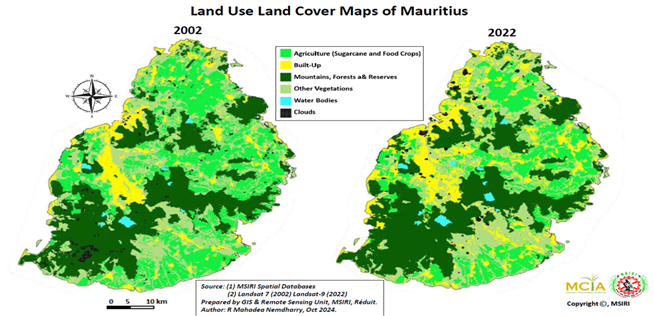
Land use in Mauritius between 2002 and 2022 has been characterized by a significant shift from vegetated landscapes to urbanized spaces, driven mainly by economic diversification and population growth. Below is the land use and land cover maps from the study. Although nearly all virgin forests have vanished, mountains and forest reserves cover 33% of Mauritius. The study shows that over the past twenty years, the proportion of agricultural land and other vegetation has declined by 9%, from 54% to 45%.
Some land types remained relatively stable due to geographic or legal protections such as mountain and forest reserves which experienced only minor losses, declining from 63,665 hectares to 61,397 hectares and currently covering approximately 33% of Mauritius. Water-covered areas have also remained stable, showing only a marginal increase from 1,335 hectares to 1,460 hectares, primarily due to the construction of the Midlands and Bagatelle Dams
The main drivers of this trend, include expansion of non-agricultural economic sectors, de-agrarianisation, and growing residential developments.
The vested interests and strategies of stakeholders
All stakeholders show concern about the challenges faced by the agricultural sector related to climate change and biodiversity loss, as well as health benefits of locally produced foods. Government and State agencies express high levels of formal recognition and their interest is largely framed in terms of balancing national food security and the preservation of the sugar sector while developing climate resilience and adhering to international policy commitments (Ministry of Agro Industry and Food Security, 2024).
Large sugar Corporation own approximately 85% of agricultural land and prioritise corporate profitability and economic diversification. The sugar industry's vested interests is two-fold: maintain sufficient sugarcane acreage to keep mills viable, while simultaneously pursuing land conversion to non-agricultural uses to maximise returns. In response, industry actors are pursuing diversification into specialty sugars, ethanol, and bagasse-based energy, alongside real estate development and technological modernisation, as strategies to sustain profitability in the face of low global sugar prices and scarce labour.
Small- and medium-scale farmers, primarily engaged in food crop production, face acute livelihood pressures driven by high production costs, low profitability, and generational disengagement from agriculture. Their responses range from land abandonment and sale, to income straddling across farm and non-farm activities, alongside calls for subsidies and improved market conditions.
NGOs and local communities, by contrast, prioritise agroecological practice, biodiversity protection, and food security for vulnerable populations, working through demonstration farming and advocacy for more inclusive policy processes.
Private sector associations such as the Mauritius Chamber of Agriculture occupy a different position, focusing on agricultural efficiency and alignment with international environmental standards, notably through smart agriculture initiatives aimed at reducing agro-chemical use in response to shifting consumer demand.
Overall, stakeholders' primary concern is the economic viability of the agricultural sector. Consequently, they emphasise the need for targeted subsidies, supportive policies, and the development of viable business models that can secure farmers' livelihoods while promoting sustainable agriculture.
Potential pathways for the future of agriculture in Mauritius
The economic, social, and environmental sustainability of the agricultural sector in Mauritius is under increasing threat. The main challenges highlighted in the study include frequent extreme weather events, disrupted food supply chains, low profitability compared to other economic sectors, young people’s preference for desk jobs and urban lifestyles, and the slow transition into ecological farming systems. All these issues require more research seeking both uniform and context-specific solutions at a global and local levels.
In addition, given the dominant position of the corporate sector in Mauritius, it has a crucial role in shaping the future of a sustainable agriculture and ecological farming systems in the Island State. On the positive side, there is a growing awareness of the main challenges related to climate change and biodiversity loss in Mauritius. Discussions around agro-ecological practices are widespread, and corporations have made progress in adopting more sustainable farming techniques.
Based on stakeholder perspectives and the study findings, several pathways could strengthen the future sustainability of agriculture which involve balancing economic growth objectives with environmental sustainability through strategic planning, technological modernisation, and policy reform. Here are key directions to ensure the sector's resilience:
First, better statistics and transparency about land conversion are needed for a fact-based policy debate, and an integrated land-use planning with proposals to reserve approximately 45,000 hectares for sugarcane and allocate a further 85,000 hectares for domestic food production based on soil suitability, in order to arrest the ongoing conversion of agricultural land to built-up uses.
Second, the transition towards agroecologically sustainable farming systems should be driven by government, researchers, and NGOs through crop rotation, intercropping, organic inputs, and smart agriculture initiatives, supported by pending organic legislation to improve farmer livelihood security.
Third, strengthen diversification into specialty sugars, ethanol, pharmaceutical alcohol, bagasse-based bioenergy, and alternative high-value crops such as hemp for the nutraceutical sector.
Fourth, reach national food self-sufficiency by implementing the government's 2024-2030 Strategic Plan, which targets 6% annual growth in food production and prioritises strategic crops such as potatoes and onions to reduce the country's heavy dependence on food imports.
Fifth, modernisation through mechanisation subsidies and adoption of technologically advanced farming methods is necessary to compensate for labour shortages and an ageing farming population, while also serving as a means of attracting younger entrants to the sector.
Finally, inclusive governance calls to move beyond large sugar industry dominance toward multi-stakeholder policy formulation processes that incorporate the views of smallholders, NGOs, and local communities, alongside a shift from subsidy dependence to viable and competitive business models.
Mauritius' experience demonstrates that the future of agriculture in Small Island Developing States depends not on choosing between economic growth and environmental sustainability, but on successfully integrating the two. Building a resilient agricultural sector will require profitable and sustainable business models, greater investment in innovation and ecological farming, and stronger collaboration among government, the private sector, researchers, NGOs, and farming communities. Above all, agriculture must become an attractive and rewarding career for younger generations, ensuring that the sector continues to contribute to national food security, biodiversity conservation, and sustainable economic development in the decades ahead.
--
You can read the full article here: Brizmohun, R., Hillbom, E., Mahadea-Nemdharry, R., & Wahab, I. (2025). What Is the Future of Agriculture in Small Island Developing States? The Case of Mauritius. Agriculture, 15(24), 2611. https://doi.org/10.3390/agriculture15242611
References
Briguglio,L.Small Island Developing States and their economic vulnerabilities. World Development. 1995, 23(9), 1615–1632. https://doi.org/10.1016/0305-750X(95)00065-K
Hnatenko, I.; Shtuler, I.; Romashko, O.; Rubezhanska, V.; Bugay, G.B. The innovative potential of agro-processing enterprises in the context of resource conservation and crisis management. J. Hyg. Eng. Des. 2021, 35, 61–66. Available online: https://keypublishing.org/jhed/wp-content/uploads/2022/09/04.-Full-paper-Iryna-Hnatenko-1.pdf (accessed on 5 November 2024).
Connell, J. Islands at Risk?: Environments, Economies and Contemporary Change; Edward Elgar Publishing: Cheltenham, UK, 2013.
Thomas, A.; Baptiste, A.; Martyr-Koller, R.; Pringle, P.; Rhiney, K. Climate Change and Small Island Developing States. Annu. Rev. Environ. Resour. 2020, 45, 1–27. https://doi.org/10.1146/annurev-environ-012320-083355
Rodrik, D. An African Growth Miracle? J. Afr. Econ. 2016, 27(1), 10–27. https://doi.org/10.1093/jae/ejw027
Charles Telfair Centre is an independent nonpartisan not for profit organisation and does not take specific positions. All views, positions, and conclusions expressed in our publications are solely those of the author(s).
Main photo: A Mauritian farmer surveying his crop, Mauritius. IWRM AIO SIDS on Flickr
Disclaimer: To bridge the gap between complex research and accessible reading, we use AI to assist in our writing process. However, every summary is human-authored and must pass a validation check by the original study’s author before publication.