

Dr Elin Thomas, Deep-sea biologist and science communicator, University of Western Australia
This study provides the most comprehensive review to date on the habitats and biodiversity of deep-sea ecosystems (deeper than 1000m) in the Indian Ocean. Most of the Indian Ocean is deeper than 1000m and deep-sea ecosystems are found within the economical exclusive zone (EEZ) of thirty Indian Ocean countries. Despite the general agreement between stakeholders, the need for considerable investments has so far prevented prioritising deep-sea research, except in areas raising commercial interests. However, data on deep-sea ecology in the Indian Ocean are critical to provide a baseline to inform future exploration, understand global ocean processes, achieve national priorities, and meet international agreements on conservation and protected areas.
Why it matters?
The Indian Ocean’s oceanographic character is distinctive. Monsoonal-forced circulation and the absence of a northern deep-water source create conditions that shape both global climate variability and deep-sea habitats in ways that remain poorly documented. Beyond its climatic significance, the ocean may serve as a key biogeographic corridor connecting Atlantic and Pacific deep-sea fauna, while its complex geomorphology, including trenches, seamounts, and hydrothermal vents, supports high levels of biodiversity. The scaly-foot snail (Chrysomallon squamiferum) is one well-documented example of a species found nowhere else on Earth.
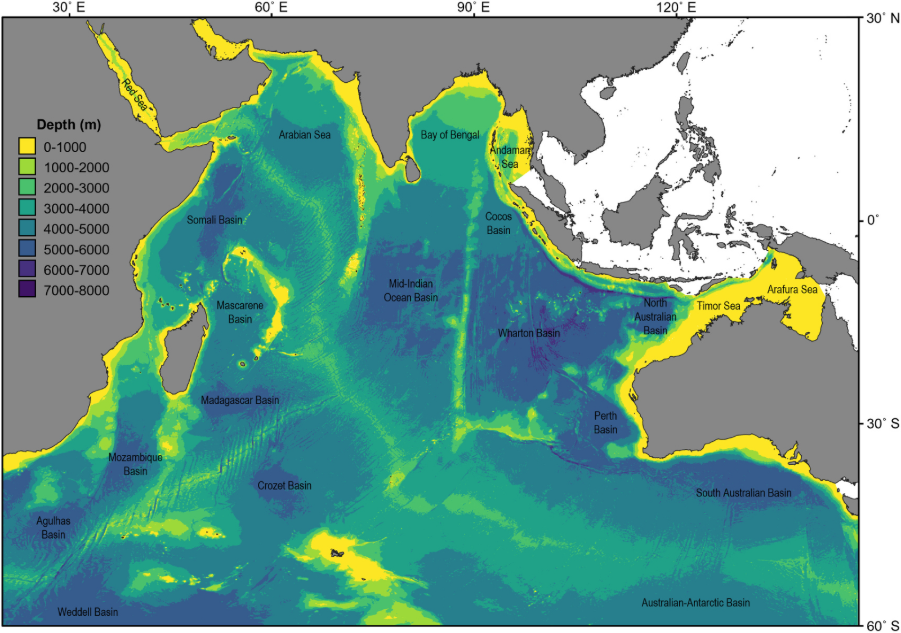
Scientific knowledge of the region is also urgently needed to address mounting governance and conservation challenges. The International Seabed Authority has already issued exploration contracts for polymetallic nodules and sulfides in Indian Ocean waters, yet the environmental baselines necessary to assess impact remain largely absent, particularly in the southern and southeastern portions of the basin. At the same time, features such as the Red Sea brine pools and oxygen minimum zones function as natural laboratories for extremophile research, with potential applications in biomedical science. Taken together, the Indian Ocean deep sea (see Figure 1) represents both a significant gap in global ocean science and a frontier with considerable scientific and policy relevance. Advancing this knowledge is directly tied to the goals of the UN Decade of Ocean Science (2021-2030).
Mapping deep-sea data
This review presents available data and major data gaps for each deep-sea ecosystem type in the Indian Ocean. The biodiversity data comes from the OBIS open-access repository. The authors acknowledge that further biodiversity assessments have taken place but remain unavailable to the public, highlighting the need to share existing data on open-access platforms.
The summary of each deep-sea ecosystem reveals extensive, yet improvable, data on the biodiversity of the Indian Ocean. The best characterised ecosystems either result from national research campaigns, mostly from India and Australia, or from industry-funded surveys. Therefore, available data are often biased towards close-to-shore locations presenting a national interest, and the shallower deep-sea habitats, which require fewer resources to explore. Continental margins, particularly around India, Australia, Tanzania, and Kenya, potential extraction sites in the mid-Indian Ocean Basin, fishery-related surveys around the Crozet, the Kerguelen, and the Madagascar Plateaus, seamounts and hydrothermal vents along the Southwest Indian Ridge, and brine pools in the Red Sea, display the greatest sampling effort.
The western, central, and eastern Indian Ocean are not equally surveyed for the same type of features. The southern Indian Ocean consistently remains the least characterized basin, partly due to its remoteness and lack of direct national interest (Ramiro-Sánchez et al., 2023).
Deep-sea habitats, their fauna and inorganic features are shaped by specific local conditions. To better understand these underwater ecologies, it is therefore important to conduct comparative studies across different locations of the same habitats, e.g. canyons (Conlan et al., 2015), oxygen minimum zones (Bristow et al., 2017; McCreary et al., 2013; Suokhrie et al., 2020), cold seeps and brine pools (Mazumdar et al., 2019; Oliver et al., 2015), ridges (Copley et al., 2016). Largely unexplored areas include the Mascarene Plateau, and Chagos-Laccadive and Ninetyeast ridges. Large areas of some ecosystems provide connectivity, sustaining gene flow and evolutionary corridors for depth-limited organisms (Weston et al., 2021) or even between oceans (German et al., 1998; Hwang et al., 2022; Perez et al., 2021). When in-situ measurements confirm their expected depth, the proximity of very deep features (>6000m), as found in the Eastern Indian Ocean, presents an unprecedented opportunity to study hadal biodiversity connectivity networks. These elements support the need for a new delimitation of Indian Ocean biogeographic provinces to improve the understanding of regional and global ocean processes.
Challenges to address
Deep-sea research faces several challenges, both globally and at the scale of this ocean.
The lack of consistency in defining the Indian Ocean borders is a recurring issue, complicating the comparison between available studies.
Data are needed across timescales as well as spatial scales. Seasonal and annual shifts are not captured by discrete data sampling campaigns, highlighting the need for sustained monitoring and time-series studies to match current practices in other oceans.
There is a bias toward shallower sampling, with the vast majority of biological records reviewed coming from depths between 1000 and 3000 m. Challenging sampling techniques causes lower recorded diversity at depths greater than 3000m, which might not reflect the biological reality of these ecosystems.
Moreover, deep-sea biodiversity assessment should not be limited to seafloor features, but also include deep water column elements, taking advantage of eDNA techniques and other emerging technologies. Abyssal plains and the deep-water column make up most of the Indian Ocean, yet there is a critical lack of biological sampling in these areas.
Thanks to technological advances and international collaborations, deep-sea research can nowadays provide valuable information on undocumented species records and distributions, anthropogenic impacts, and global changes, yielding high-ranking scientific publications. When areas are beyond national jurisdiction – two-thirds of the Indian Ocean – or research funds and capacity are lacking in a single country, partnerships with industries (fisheries, mining, gas and oil, pharmaceuticals) can be instrumental in filling knowledge gaps.
Although the current limited research shows that the deep Indian Ocean is relatively spared compared to other oceans, deep-sea trawling, mining, and litter pollution (e.g., microplastic fibres, fishing gear) pose significant threats to deep-sea habitats, especially when these are located near major hubs. Findings in the Indian Ocean's deep-sea should therefore be interpreted within a global context of marine conservation and take into consideration biological interconnectivity across maritime zones.
References:
Bristow, L. A., Callbeck, C. M., Larsen, M., Altabet, M. A., Dekaezemacker, J., Forth, M., Gauns, M., Glud, R. N., Kuypers, M. M. M., Lavik, G., Milucka, J., Naqvi, S. W. A., Pratihary, A., Revsbech, N. P., Thamdrup, B., Treusch, A. H., & Canfield, D. E. (2017). N2 production rates limited by nitrite availability in the Bay of Bengal oxygen minimum zone. Nature Geoscience, 10(1). https://doi.org/10.1038/ngeo2847
Conlan, K. E., Currie, D. R., Dittmann, S., Sorokin, S. J., & Hendrycks, E. (2015). Macrofaunal Patterns in and around du Couedic and Bonney Submarine Canyons, South Australia. PLOS ONE, 10(11). https://doi.org/10.1371/journal.pone.0143921
Copley, J. T., Marsh, L., Glover, A. G., Hühnerbach, V., Nye, V. E., Reid, W. D. K., Sweeting, C. J., Wigham, B. D., & Wiklund, H. (2016). Ecology and biogeography of megafauna and macrofauna at the first known deep-sea hydrothermal vents on the ultraslow-spreading Southwest Indian Ridge. Scientific Reports, 6(1). https://doi.org/10.1038/srep39158
German, C. R., Baker, E. T., Mevel, C., Tamaki, K., & Team, t. F. S. (1998). Hydrothermal activity along the southwest Indian ridge. Nature, 395(6701). https://doi.org/10.1038/26730
Hwang, H.-s., Cho, B., Cho, J., Park, B., & Kim, T. (2022). New Record of Hydrothermal Vent Squat Lobster (Munidopsis lauensis) Provides Evidence of a Dispersal Corridor between the Pacific and Indian Oceans. Journal of Marine Science and Engineering, 10(3), 400. https://doi.org/10.3390/jmse10030400
Mazumdar, A., Dewangan, P., Peketi, A., Gullapalli, S., Kalpana, M. S., Naik, G. P., Shetty, D., Pujari, S., Pillutla, S. P. K., Gaikwad, V. V., Nazareth, D., Sangodkar, N. S., Dakara, G., Kumar, A., Mishra, C. K., Singha, P., & Reddy, R. (2019). The first record of active methane (cold) seep ecosystem associated with shallow methane hydrate from the Indian EEZ. Journal of Earth System Science, 128(1). https://doi.org/10.1007/s12040-018-1044-y
McCreary, J. P., Yu, Z., Hood, R. R., Vinaychandran, P. N., Furue, R., Ishida, A., & Richards, K. J. (2013). Dynamics of the Indian-Ocean oxygen minimum zones. Progress in Oceanography, 112-113. https://doi.org/10.1016/j.pocean.2013.03.002
Oliver, P. G., Vestheim, H., Antunes, A., & Kaartvedt, S. (2015). Systematics, functional morphology and distribution of a bivalve (Apachecorbula muriatica gen. et sp. nov.) from the rim of the ‘Valdivia Deep’ brine pool in the Red Sea. Journal of the Marine Biological Association of the United Kingdom, 95(3). https://doi.org/10.1017/S0025315414001234
Perez, M., Sun, J., Xu, Q., & Qian, P.-Y. (2021). Structure and Connectivity of Hydrothermal Vent Communities Along the Mid-Ocean Ridges in the West Indian Ocean: A Review. Frontiers in Marine Science, 8. https://doi.org/10.3389/fmars.2021.744874
Ramiro-Sánchez, B., Martin, A., & Leroy, B. (2023). The epitome of data paucity: Deep-sea habitats of the Southern Indian Ocean. Biological Conservation, 283. https://doi.org/10.1016/j.biocon.2023.110096
Suokhrie, T., Saraswat, R., & Nigam, R. (2020). Lack of denitrification causes a difference in benthic foraminifera living in the oxygen deficient zones of the Bay of Bengal and the Arabian Sea. Marine Pollution Bulletin, 153. https://doi.org/10.1016/j.marpolbul.2020.110992
Weston, J. N. J., Peart, R. A., Stewart, H. A., Ritchie, H., Piertney, S. B., Linley, T. D., & Jamieson, A. J. (2021). Scavenging amphipods from the Wallaby-Zenith Fracture Zone: Extending the hadal paradigm beyond subduction trenches. Marine Biology, 168(1). https://doi.org/10.1007/s00227-020-03798-4
- You can read the full article here: Thomas, E.A., Bond, T., Kolbusz, J.L., Niyazi, Y., Swanborn, D. J. B. and Jamieson, A. J. (2024). Deep-sea ecosystems of the Indian Ocean >1000 m. Science of The Total Environment,Volume 957. Available at https://doi.org/10.1016/j.scitotenv.2024.176794.
Main photo: Pexel.
Charles Telfair Centre is an independent nonpartisan not for profit organisation and does not take specific positions. All views, positions, and conclusions expressed in our publications are solely those of the author(s).