

Dr Aleksandra Peeroo, Senior Lecturer in Economics, Hertfordshire Business School
Dr Lianne Ooosterbaan, Senior Lecturer, Hertfordshire Business School
Introduction
Across Small Island Developing States (SIDS) like Mauritius, water allocation is influenced by both specific SIDS characteristics – including their insularity, limited scales, and distinct vulnerabilities – and colonial legacies that persist beyond independence (Ndlovu-Gatsheni, 2013). Exploring solutions to water challenges across the contexts of small islands requires that all these specificities be taken into account.
Until now, however, research looking at water challenges in SIDS has often overlooked these distinct characteristics. Concurrently, debates on the decolonisation of water governance have mostly focused on larger, continental contexts (Ross, 2024), whose realities vastly differ from those of SIDS.
This study seeks to address this gap by looking at the case of three formerly colonised SIDS namely, Mauritius, Papua New Guinea, and Cabo Verde. It highlights ongoing colonial power imbalances in water allocation and provides critical insights into the need for context-based solutions in the process of decolonising water allocation in SIDS. In so doing, it warns against neoliberal approaches to water resource governance that might reproduce colonial dynamics.
Why does this matter?
Climate change effects such as increased temperatures, less and more intense rainfall, and higher rates of extreme weather events, impact both the quantity and quality of water resources (Ciampittiello et al., 2024). This exacerbates problems of pollution from economic activities, leading to increased contamination from chemicals, microplastics, and untreated effluents. This not only threatens the quality of water resources but also necessitates advanced technologies to provide safe drinking water (Gude, 2021).
For SIDS, this issue is made even more severe given their heightened vulnerability to climate change, their limited resources, and rising per capita water consumption due to high population densities (Cashman, 2014). Extreme weather events, such as cyclones, also pose risks of damaging water infrastructure and polluting water resources. Droughts also further reduce generally already scare water resources, and floods – including flash floods –, contaminate water through sedimentation and disrupt water supply (Falkland, 1999). Consequently, there is increased competition between alternative water uses, resulting in water being directed towards economically relevant activities such as agriculture or tourism, risking further depletion (Gohar et al., 2019).
Severe budgetary pressures and limited fiscal space to finance and maintain water infrastructure further exacerbate the situation. In addition, infrastructure costs in SIDS are higher than in non-SIDS, where remoteness and limited economic diversification mean that materials critical for maintaining water infrastructure must be imported at high transportation costs and paid for in foreign exchange.
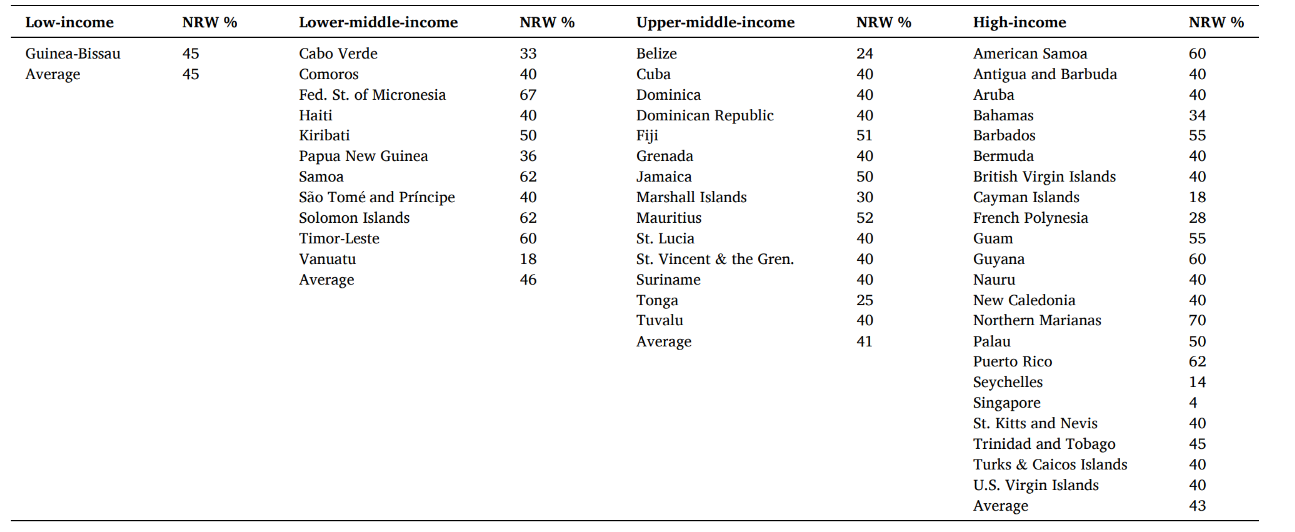
As a result, maintenance and operation of water infrastructure are often underfunded and neglected. This is made clear when looking at non-revenue water (NRW, see Table 1), which measures the amount of water fed into the distribution system but not generating any revenue due to physical losses – for example, through leaky pipes – and commercial losses – for example, illegal connections or faulty water meters. Mauritius, for instance, loses 52% of the water channelled into its distribution system1, while Cabo Verde and Papua New Guinea lose 33% and 36% respectively. To address these many challenges, SIDS require institutional reforms to achieve more effective and fairer water governance (Closas & Villholth, 2020). This study highlights that, for such reforms to be successful, they would need to integrate a decolonial approach to address ongoing colonial dynamics.
Colonial legacies in SIDS water allocations
The case of Mauritius
The colonial project in Mauritius required more freshwater resources as from the 1850s due to the expansion of sugarcane plantations. To secure water for plantations, the Rivers and Canal Act granted riparian water rights to landowners with an adjacent stream (Government of Mauritius, 1863). Although section three of the law read that “all rivers and streams are public property”, sugar estates were now formally entitled to extract water from adjoining rivers to irrigate their crops for free (Government of Mauritius, 1863).
These water rights endured post-independence. The Ground Water Act (Government of Mauritius, 1970) and the responsibilities attributed to the Central Water Authority (Central Water Authority Act, 1971) for the control, development, and conservation of both ground and surface water resources established that both ground and surface water are public property. The Water Resources Act 2024 also clearly stipulates in section five that all water resources belong to the public domain. However, it also protects and even strengthens existing water rights deriving from the original 1863 law.
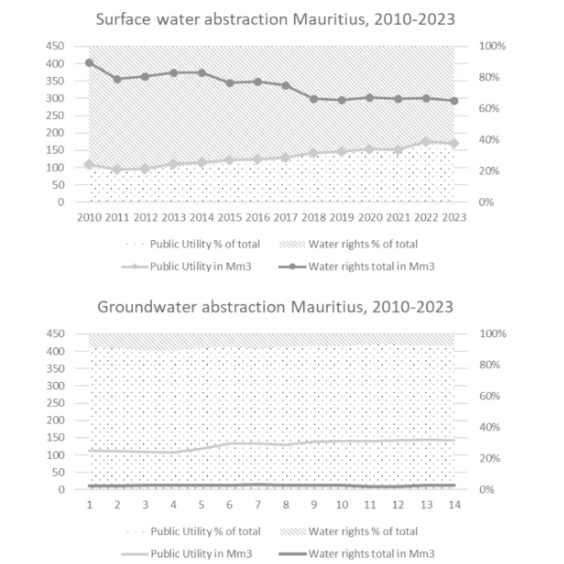
Looking at freshwater resource extraction between 2010 and 2023 (see figure 1 this study finds that the public utility has consistently accounted for 90% of groundwater use over the period. On the other hand, riparian water rights holders, usually entitled to extract up to 90% of the average flow from rivers (Proag, 1995), accounted for the free withdrawal of two-thirds of all abstracted surface water from 2010 to 2023. Overall, water extraction by riparian water rights holders stands at 48% as of 2023, meaning they extract about the same amount of water as the public.
Socio-economic impacts
This pressure on surface water resources not only has an environmental impact but also leads the government to engage in the costly construction of large-scale infrastructure, with additional reservoirs providing a supply-side solution to seasonal water scarcity (Peeroo, 2016).
Riparian water rights also contribute to social inequalities. While water rights holders can extract water for free, small landowners are provided with either:
- drinking water for the irrigation of their plots, at a tariff of about 50% higher than that applied to domestic consumers, or
untreated freshwater for 60% of the tariff to domestic consumers.
This unequal treatment has led to small landowners abandoning more that 25% of land previously used for cultivation (To, Seebaluck and Leach, 2018).
At the same time, the CWA is starved of funds to improve its services. Households thus have to invest privately in improving their water access by installing and maintaining a water storage tank, with government subsidies for low-income households, and a pump to increase flow pressure (Peeroo and Bayliss, 2025). This study highlights that imposing the same tariffs on water rights holders as on small landowners paying the tariff for untreated water would likely double the CWA’s revenues. This could provide needed funds to improve drinking water services, all while alleviating the financial burden on households.
The case of Cabo Verde
Cabo Verde became independent from Portugal in 1975. While the colonial water code considered water private property, the independent government sought to break away from this perception to make water accessible to small farmers and sharecroppers. The country’s constitution today considers water to be the property of the state and the “common heritage of the people” (Bosa, 2015). However, colonial water laws continue to affect current water laws, with landowners whose lands have a spring considering that water as private property. Furthermore, governments after independence also facilitated the introduction of new private actors, with the country encouraging the privatisation and commercialisation of water despite it being seen as a Western imposition (Bosa, 2015).
The case of Papua New Guinea
During its occupation, Papua New Guinea followed English Common Law, which included riparian water use rights (Kalinoe, 1998b). Papua New Guineans, however, did not accept the colonial legislation and preferred to adhere to their customs. When the country’s independent constitution was drafted, members of the indigenous Constitutional Planning Committee pushed for the recognition of customary law (Weisbrot, 1981). As a result, upon independence from Australia in 1975, English Common Law would not be applied if inconsistent with custom (Kalinoe, 1998a). In this case, Indigenous claims to water have helped resist colonial water resource allocations. However, friction arises between customary law and Western standards as social changes such as urbanisation unfold. For example, the fact that most land is still held customarily stops companies responsible for delivering piped drinking water (Water PNG and Eda Ranu) from establishing new water connections on land that is not formally owned. This leads to inequalities along social, economic, and political lines (Rooney, 2021), with only 9% of the population having access to piped drinking water (Department of National Planning and Monitoring, 2010).
Towards decolonising water resource allocations
Mauritius’ case highlights the limits of decolonisation, where economic power remains concentrated in the hands of a privileged group. How then can a country go about fully decolonising its water distribution system? Looking at the cases of Cabo Verde and New Papua Guinea, this study foregrounds the idea that achieving this goal would require adapting solutions to the specific context of each SIDS, since they differ in their colonial trajectories. It highlights two important factors that influence continued colonial influence in current water governance. These include:
- The presence of an Indigenous population: Unlike Papua New Guinea, Mauritius and Cabo Verde were inhabited prior to colonisation. This lack of Indigenous claims to water might facilitate postcolonial water resource allocations, with countries like Mauritius and Cabo Verde favouring allocation to powerful private actors.
Abundance of water resources: Papua New Guinea does not lack freshwater, while both Mauritius and Cabo Verde experience water stress. This study posits that where water is less readily abundant, power relations and economic imperatives will more clearly determine water allocations.
Decolonising water resource allocations across SIDS would therefore require context-based solutions. In that sense, there is a need to critically assess one-size-fits-all approaches to water governance promoted by multilateral agencies, since organisations such as the World Bank and the IMF tend to pressurise developing nations to commercialise or even privatise their water supplies. However, capitalising on natural resources is ingrained in colonialism (Roca-Servat et al, 2021). In that sense, and given SIDS high reliance on external actors and financing mechanisms, this study calls for resisting neoliberal approaches to water governance.
- You can read the full article here: Oosterbaan, L. and Peeroo, A., 2026. Decolonising water resource allocations: towards a typology of experiences in small island developing states. Geoforum, 170, p.104563. https://doi.org/10.1016/J.GEOFORUM.2026.104563
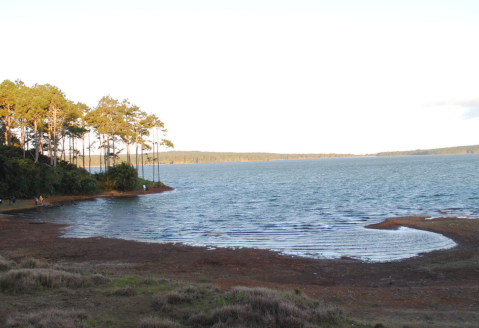
Main photo: Midlands dam, Mauritius. Flickr
Charles Telfair Centre is an independent nonpartisan not for profit organisation and does not take specific positions. All views, positions, and conclusions expressed in our publications are solely those of the author(s).
References:
Bosa, M.S., 2015. ‘Water institutions and management in Cape Verde’, Water, 7, pp.
2641-2655. Available at: https://doi.org/10.3390/W7062641.
Cashman, A., 2014. ‘Water security and services in the Caribbean’, Water, 6, pp.
1187–1203. Available at: https://doi.org/10.3390/w6051187
Ciampittiello, M., Marchetto, A., Boggero, A., 2024. ‘Water Resources Management
under Climate Change: A Review’, Sustainability (Switzerland), 16(9), p. 3590.
Available at: https://doi.org/10.3390/SU16093590/S1.
Closas, A., Villholth, K.G., 2020. ‘Groundwater governance: Addressing core concepts
and challenges’, Wiley Interdisciplinary Reviews: Water, 7(1), p. e1392. Available at:
https://doi.org/10.1002/WAT2.1392
Department of National Planning and Monitoring, 2010. Papua New Guinea development strategic plan 2010-2030.
Falkland, T., 1999. ‘Water resources issues of small island developing states’, Natural
Resources Forum, 23(3), pp. 245–260. Available at: https://doi.org/10.1111/j.1477-
8947.1999.tb00913.x
Proag, V., 1995. The Geology and Water Resources of Mauritius. Mahatma Gandhi Institute, Moka
Government of Mauritius, 1863. Rivers and Canals Act. Available at: https://cwa.govmu.
org/cwa/wp-content/uploads/2022/07/RIVERS-AND-CANALS-ACT-Cap-421.pdf
Government of Mauritius, 1970. Ground Water Act. Available at: https://publicutilities.
govmu.org/Documents/2020/Legislation/Water/Central%20Water%20Authority/
Groundwater/groundwater31.pdf?csf=1&e=N3hokx
Government of Mauritius, 1971. The Central Water Authority Act. Available at: https://
publicutilities.govmu.org/Documents/2020/Legislation/Water/
centralwaterauthorityact19711.pdf?csf=1&e=7OZ06U#:~:text=The%20Authority
%20shall%20be%20responsible,and%20conservation%20of%20water%
20resources.&text=(1)%20Subject%20to%20subsection%20(,property%2C%20or%
20make%20any%20donation
Gude, V.G., 2021. ‘One water – evolving roles of our precious resource and critical
challenges’, AQUA - Water Infrastructure, Ecosystems and Society, 70(4), pp. 467–482.
Available at: https://doi.org/10.2166/AQUA.2021.154.
Kalinoe, L., 1998a. The common law riparian rights doctrine and its applicability In
Papua New Guinea. Melanesian Law Journal 2, 1–20.
Kalinoe, L., 1998b. Water law and the nature of customary water rights in. University of
Wollongong, Papua New Guinea
Liemberger, R., Wyatt, A., 2018. Quantifying the Global Non-Revenue Water Problem.
Available at: https://doi.org/10.2166/ws.2018.129.
Liemberger, R., Wyatt, A., 2019. ‘Quantifying the global non-revenue water problem’,
Water Supply, 19(3), pp. 831–837. Available at: https://doi.org/10.2166/
WS.2018.129.
Ndlovu-Gatsheni, S.J., 2013. Coloniality of Power in Postcolonial Africa – Myths of
Decolonization. CODESRIA Books Publication System.
Peeroo, A., 2016. ‘The Institutional Setting of Mauritian Water Sector Governance: What Place for Sustainability?’, in A. Peeroo and R. Sultan (eds) Governance and Economic
Accounting Issues in the Mauritian Water Sector: Towards Sustainable Management of a
Natural Resource. Washington, DC and others: Global Development Network (GDN),
pp. 68–90.
Peeroo, A., Bayliss, K., 2025. A Political Economy Perspective on Mauritian Water
Services. In: Oya, C., Ramtohul, R., Tandrayen-Ragoobur, V. (Eds.), The Oxford
Handbook of the Mauritian Economy. Oxford University Press (OUP).
Roca-Servat, D., Arias-Henao, J.D., Botero-Mesa, M., 2021. ‘Decolonizing hegemonic
approaches of water: exploring Latin American proposals for communality and
community entanglements’, Ambiente e Sociedade, 24, pp. 1–20. Available at:
https://doi.org/10.1590/1809-4422asoc20200096r1vu2021L4TD
Rooney, M.N., 2021. ‘“We want development”: Land and water (dis)connections in Port Moresby, urban Papua New Guinea’, Contemporary Pacific, 33(1), pp. 1–30.
Available at: https://doi.org/10.1353/cp.2021.0001
Ross, C., 2024. Liquid Empire: Water and Power in the Colonial World. Princeton: Princeton University Press. Available at: https://doi.org/10.1515/9780691261232.
To, L., Seebaluck, V., Leach, M., 2018. Future energy transitions for bagasse
cogeneration: Lessons from multi-level and policy innovations in Mauritius. Energy
Res. Soc. Sci. 35, 68–77. https://www.sciencedirect.com/science/article/pii/
S2214629617303833.
Weisbrot, D., 1981. Customizing the Common Law: the True Papua New Guinea
Experience. American Bar Association Journal 67 (6), 727–731.